
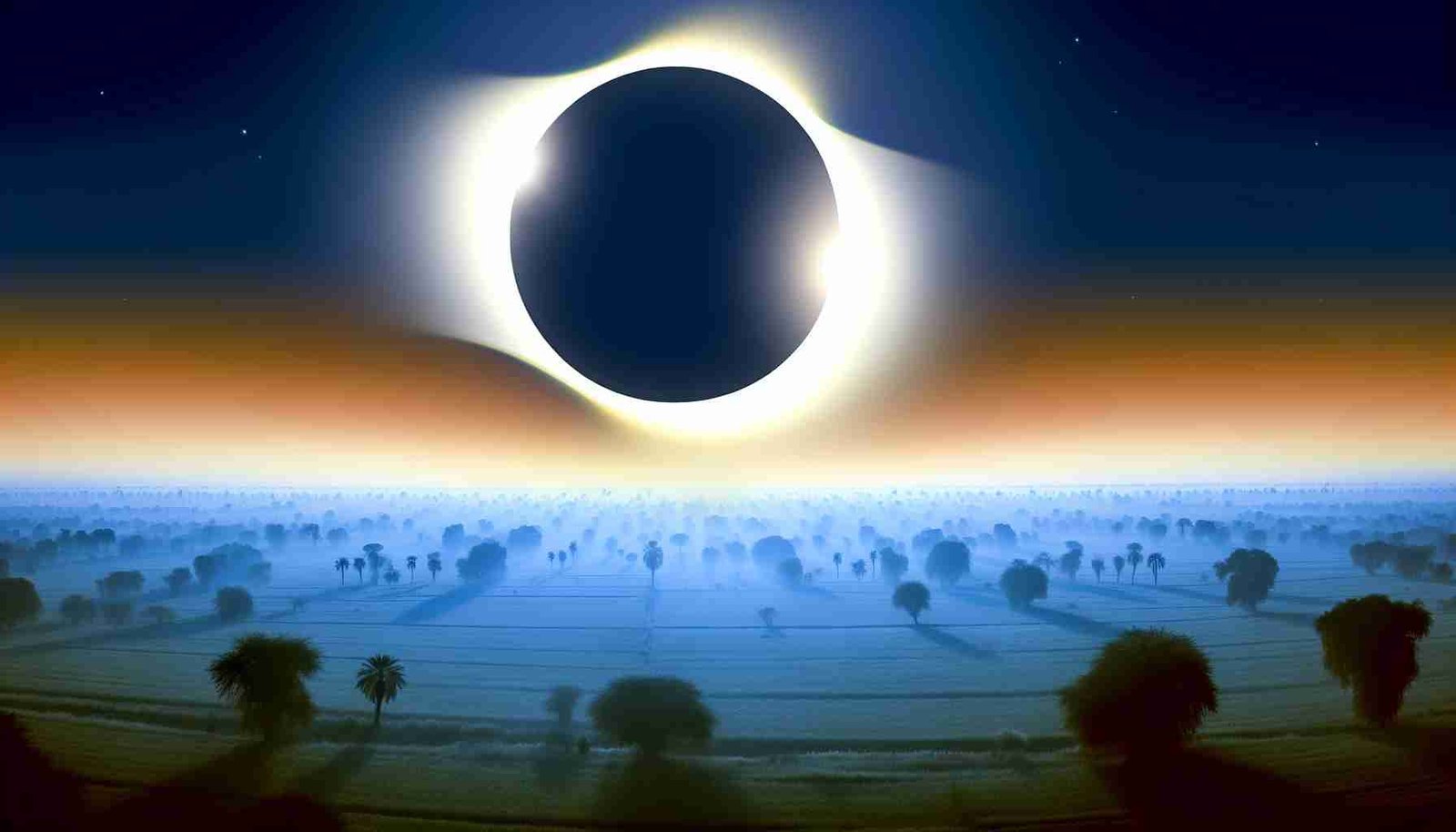
Prepare to be captivated by the annular solar eclipse in India, an event that transforms the daytime sky into a collar of light. Discover everything you need to know about this awe-inspiring celestial phenomenon, how it occurs, and the best places and times to witness it. Embrace the magic of the skies, guided by innovation and learning.
Table of Contents
Understanding the Annular Solar Eclipse
Understanding the intricate dance of celestial bodies during an annular solar eclipse is nothing short of fascinating. Unlike a total solar eclipse, where the moon completely blankets the sun, an annular eclipse occurs when the moon’s apparent size is insufficient to cover the sun entirely, leaving a glowing ring, coined as the “Ring of Fire”. This phenomenon hinges on the elaborate ballet involving the Earth, moon, and sun, governed by the laws of orbital mechanics.
At the heart of an annular solar eclipse is the concept of syzygy— a straight-line configuration of three celestial bodies. This alignment occurs during a new moon phase when the moon finds itself between the Earth and sun. However, the moon’s elliptical orbit means its distance from Earth varies, affecting its apparent size in our sky. When the moon is farther away, it appears smaller and cannot completely obscure the sun, framing the annular solar eclipse’s hallmark ‘ring’.
This celestial spectacle is underscored by the dynamics of perigee and apogee—the closest and farthest points of the moon’s orbit to the Earth, respectively. An annular eclipse happens near or at the apogee, where the moon’s reduced size fails to blanket the sun fully. This contrasts starkly with a total solar eclipse, witnessed when the moon, at or near its perigee, suffices to envelop the sun entirely when aligned.
The variance in the apparent sizes of the sun and moon is crucial in differentiating between a total and annular eclipse. During an annular eclipse, the sun’s luminous ring remains visible, a result of the angular diameter of the sun exceeding that of the moon from our terrestrial viewpoint. This discrepancy in size stems from the vast distances separating these celestial bodies from Earth, intertwined with their respective sizes.
To visually digest this concept, imagine two coins at varying distances—one closer and one further away. If aligned correctly, the farther coin can seem smaller, mimicking the moon’s appearance during an annular eclipse, compared to the nearer coin, representative of the sun’s relative size. This analogy encapsulates the essence of the annular eclipse phenomenon, a mesmerizing display of cosmic proportions and distances.
Ultimately, experiencing an annular solar eclipse offers a unique glimpse into the meticulous clockwork of our universe, highlighting the precision of celestial mechanics. It’s a vivid reminder of the awe-inspiring phenomena that unfold in our cosmos, governed by the laws of physics and our position within this vast expanse. For those interested in exploring celestial events further, diving into the intricacies of astronomical phenomena can unveil a world of cosmic wonder.
When and Where to View the Eclipse in India
Witnessing an annular solar eclipse is a profound experience, offering a unique opportunity to connect with the cosmos in ways that are often hard to describe. India, with its rich tapestry of culture, history, and astronomy, provides a stunning backdrop for this celestial event. Knowing when and where to view the eclipse can enhance this experience, blending science with the spiritual and cultural significance that these events hold across different parts of the country.
The annular solar eclipse, characterized by its ‘ring of fire’, can be best observed in specific locations within India where the path of annularity passes. The most optimal viewing locations often lie along a narrow path where the moon’s antumbral shadow falls on the Earth’s surface. It’s imperative for enthusiasts to position themselves within this path to experience the annular phase of the eclipse fully.
Safe viewing practices are crucial during an eclipse. It’s important to protect your eyes with approved solar viewing glasses or viewers. Traditional pinhole projectors, or projecting the image of the sun through a telescope onto a surface, are safe indirect methods to view the eclipse. Never look directly at the sun without proper eye protection, as it can cause permanent eye damage.
Beyond the scientific appeal, eclipses have a deep cultural and historical significance in India, offering a moment when modern astronomy intersects with ancient traditions and lore. In many cultures across India, eclipses are considered important omens, affecting the cosmic balance of power between the deities and demons in the heavens.
The eclipse offers a moment to delve into stories from the Hindu epics, such as the famous tale from the *Mahabharata* about the demon Rahu’s attempt to steal the nectar of immortality, leading to the phenomenon of the solar eclipse. Such tales are not just mythological stories but are ingrained in the cultural fabric, influencing rituals and practices viewed during these celestial events Cricket and Lunar Myths.
For those keen on blending the observation with technology, various apps and websites provide precise timings, locations, and paths of eclipses. Utilizing such technology not just enriches the viewing experience but also educates on the multifaceted aspects of these celestial events, thus linking directly to how technology and astronomy intersect in understanding and appreciating our universe.
In summary, viewing an annular solar eclipse in India is not just about witnessing a rare astronomical event; it’s an immersion into an experience rich with cultural, historical, and scientific significance. The key to fully appreciating this phenomenon lies in understanding the optimal locations and times for viewing, employing safe practices during observation, and embracing the deep cultural narratives that give such events their unique place in the tapestry of life.
The Intersection of Technology and Astronomy
After marking your calendars and selecting the perfect viewing location for the annular solar eclipse in India, it’s time to dive deeper into how technology intersects with astronomy to bring these celestial events closer to us than ever before. The advancements in technology, particularly with artificial intelligence (AI) and automation, have revolutionized our approach to predicting and observing celestial phenomena like solar eclipses.
AI and automation have become invaluable tools in the field of astronomy. They process vast amounts of data from past eclipses to improve the accuracy of future predictions. Such technological advancements allow scientists to analyze patterns and anomalies in celestial movements with unprecedented precision. This not only aids in the prediction of eclipses but also enhances our understanding of the complex dynamics of our solar system.
One of the most groundbreaking applications of technology in astronomy is the development of innovative AI solutions that assist in research and data analysis. These solutions can process and interpret data at speeds and scales that were unimaginable a few decades ago. By leveraging machine learning algorithms, researchers can now predict the exact timings, locations, and paths of solar eclipses with remarkable accuracy. This has opened up new avenues for amateur astronomers and enthusiasts, empowering them with the tools and knowledge to observe these celestial events accurately.
Moreover, automation plays a crucial role in the operation of observatories and telescopes. Automated systems can precisely align telescopes to track celestial objects, maintaining focus on the sun during an eclipse. This automation ensures that high-quality, consistent observations are made without the need for constant manual adjustment.
For those interested in the interplay between technology and celestial events, an in-depth look at how automation and AI are maximizing the benefits of solar eclipse observations can be found here. This exploration sheds light on the incredible potential of these technologies to enhance our celestial experiences.
The fusion of technology and astronomy has not only facilitated the prediction and observation of solar eclipses but has also democratized access to these events. No longer confined to the realms of professional astronomers, the wonders of the cosmos are now within reach of anyone with an interest and internet access. As we continue to embrace community and innovation in the following discussions, remember that it is technology that enables us to connect and share in the awe-inspiring spectacle of events like an annular solar eclipse.
Embrace Community and Innovation
Embrace Community and Innovation
After diving into the fascinating intersection of technology and astronomy, where the prowess of AI tools and automation brings us closer to the mysteries of the cosmos, it’s time to turn our gaze towards harnessing these advancements collectively. The essence of astronomical pursuits lies not just in singular achievements but thrives in community and collaborative endeavor. It is here, at the confluence of individual curiosity and collective wisdom, where real magic unfolds.
In the grand tapestry of the cosmos, events like the annular solar eclipse serve as a reminder of our place in the universe and our quest for knowledge. Observing these events unites us, sparking conversations and collaborations that push the boundaries of our understanding. However, to truly leverage these celestial events, integrating innovation in our approach becomes indispensable.
Imagine a platform that not only arms you with sophisticated AI tools but wraps around a thriving community pulsating with the shared passion for astronomy. This is not a far-fetched reality but a tangible ecosystem available at our fingertips. By joining a vibrant community such as https://onlinethinking.io/community/, enthusiasts, beginners, and seasoned astronomers alike can converge on a common ground. This platform stands as a beacon for those inclined towards celestial events like the annular solar eclipse, offering a space to access resources, share observations, and engage in enriching discussions.
The convergence of AI in astronomy, as highlighted in our exploration of technology’s role, opens up unprecedented avenues for research and discovery. However, the true potential of these tools is unleashed when paired with the collective intellect and insights of a community. It is through the amalgamation of diverse perspectives, experiences, and knowledge that we can construct a more comprehensive understanding of the cosmos.
In essence, embracing community and innovation does not merely enhance our engagement with events like the annular solar eclipse. It redefines it. It transforms a moment of solitary wonder into a shared journey of discovery, amplifying the thrill of exploration with the warmth of companionship. This approach democratizes astronomy, making it accessible and engaging for anyone bewitched by the night sky’s mysteries.
Therefore, as we stand on the brink of witnessing the annular solar eclipse in India, let’s not limit ourselves to mere observation. Let’s dive into the vibrant community awaiting us, equipped with the tools of innovation, ready to unravel the celestial mysteries together. Join the journey at OnlineThinking.io, and be part of a collective endeavor that transcends boundaries and sparks a new era of astronomical exploration.
Final words
The annular solar eclipse in India offers a breathtaking experience, symbolizing the celestial dance between the Earth, moon, and sun. As you prepare to witness this event, consider how the power of community and innovation can guide your observations and deepen your understanding of such phenomena. Explore, learn, and marvel at the wonders of the universe.